How to read SEC filings to check a stock claim comes down to one habit: split the claim into parts, then ask which filing would have to contain each part if it were true. An earnings figure belongs in an 8-K results release. A risk the company faces belongs in a 10-Q or 10-K. An insider trade belongs in a Form 4. If the part is not there, the filings do not address it, and the claim rests on the posts alone.
This guide explains what each of those filings is, where to find them, and how to read the section that matters, with real examples from stocksonar’s evidence cards for Apple (AAPL) and Costco (COST) for the week of 26 October to 1 November 2026. It is the fourth step in how to tell if stock hype is real: after you know a conversation is loud and how it behaves, you check what it says.
SEC filings explained: the four that settle most claims
US public companies report to the Securities and Exchange Commission on a fixed set of forms. Four of them cover nearly every claim you will see repeated in stock posts:
| Form | What it is | When it is filed | Claims it can check |
|---|---|---|---|
| 8-K | Current report on a major event | Generally within four business days of the event | Reported quarterly results, leadership changes, deals, other material events |
| 10-Q | Quarterly report, unaudited financial statements | For each of the first three fiscal quarters | Quarterly figures, risks the company describes, insiders’ trading plans |
| 10-K | Annual report, audited financial statements | Once a year | Full-year results, business description, risk factors, legal proceedings |
| Form 4 | An insider’s change in ownership | Generally within two business days of the transaction | Whether an insider transaction happened, when, and what kind it was |
Investor.gov, the SEC’s site for individual investors, describes each in its glossary: Form 8-K, Form 10-Q, Form 10-K and Forms 3, 4 and 5. What none of them contain is just as useful to know: launch-week unit sales, order numbers, analysts’ expectations, “whisper numbers” and anything about the share price tomorrow.
What is an 8-K?
An 8-K is the company telling the market that something significant has happened. Investor.gov describes it as a “current report” and notes that companies generally have four business days to file one. Results releases arrive this way: the company files an 8-K, usually under Item 2.02 (results of operations and financial condition), and attaches the press release as an exhibit, often numbered 99.1. That exhibit is where the headline revenue and earnings per share figures are.
A real example. In the week of 26 October 2026, Apple posts said the company would report its fourth-quarter results on 2 November after the close, that it had guided revenue growth of 9% to 11%, and that its last two quarters’ earnings per share were about $2.01 and $2.02. The evidence card split that into four parts:
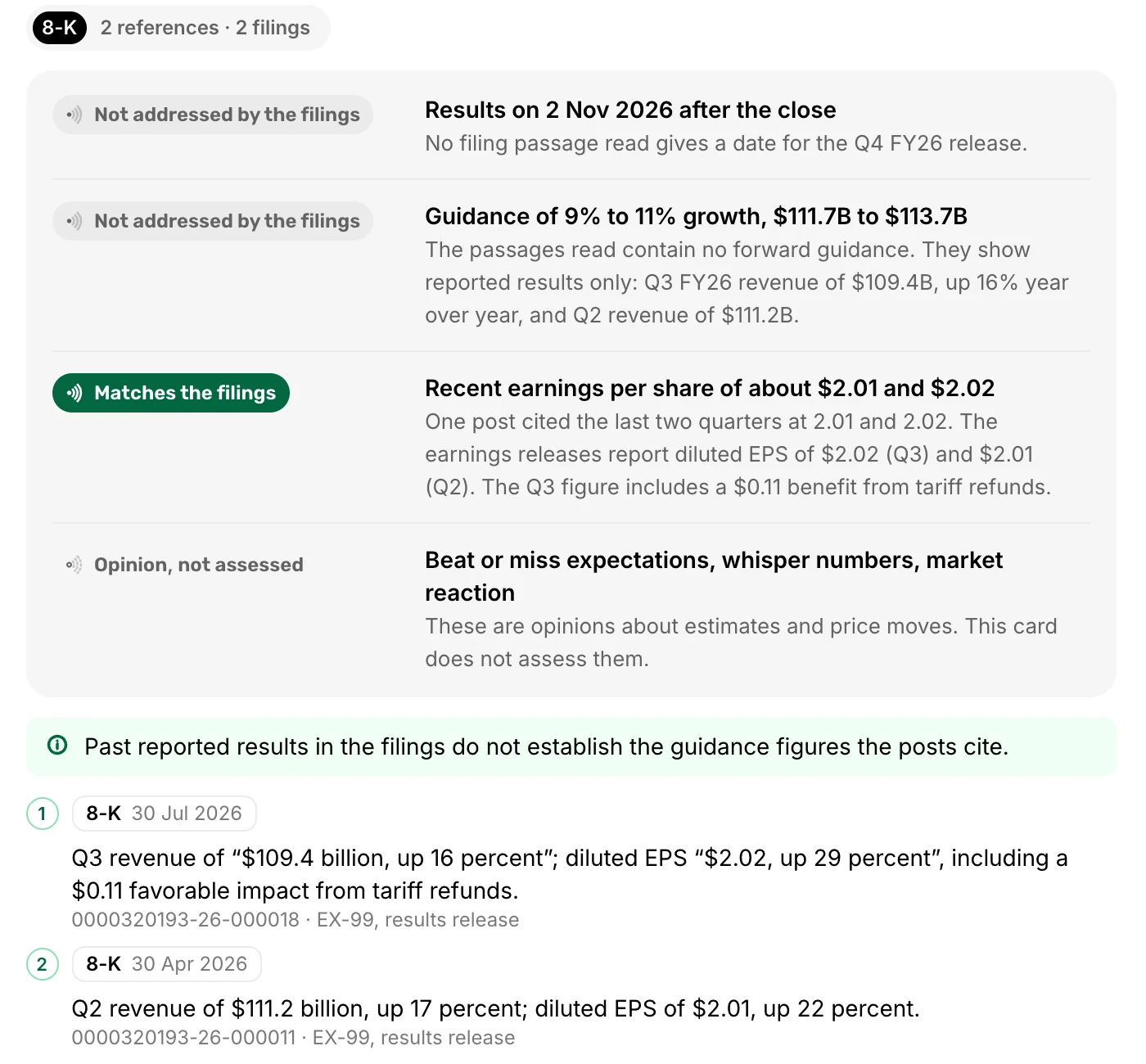
- Matches the filings: earnings per share of about $2.01 and $2.02. The 8-K results releases of 30 April and 30 July 2026 report diluted EPS of $2.01 (Q2) and $2.02 (Q3). The card adds that the Q3 figure includes a $0.11 benefit from tariff refunds, which the posts did not mention.
- Not addressed by the filings: the results date, and the 9% to 11% guidance. The passages read contain reported results only, no forward guidance and no release date.
- Opinion, not assessed: whether Apple would beat expectations, and how the market would react.
Notice what happened. A thread that sounded like one confident claim turned out to be one checked fact, two figures the filings cannot confirm, and an opinion. That is the normal shape of a stock claim.
What is a 10-Q, and how is it different from a 10-K?
The 10-Q is the quarterly report, filed for each of the first three quarters of the company’s fiscal year with unaudited financial statements. The 10-K is the annual report, with audited statements, a full description of the business and its risk factors. For checking claims, three sections do most of the work: management’s discussion and analysis (the company explaining its own numbers), the risk factors, and the legal proceedings note.
These reports are written in general terms, so they often support a claim only partly. Apple posts in the same week said the new iPhone Duo had sold out on launch day, that orders were up 30%, that 8 to 10 million units were planned, and that Apple was looking for more supply. The card checked each part against Apple’s 10-Q of 31 July 2026:
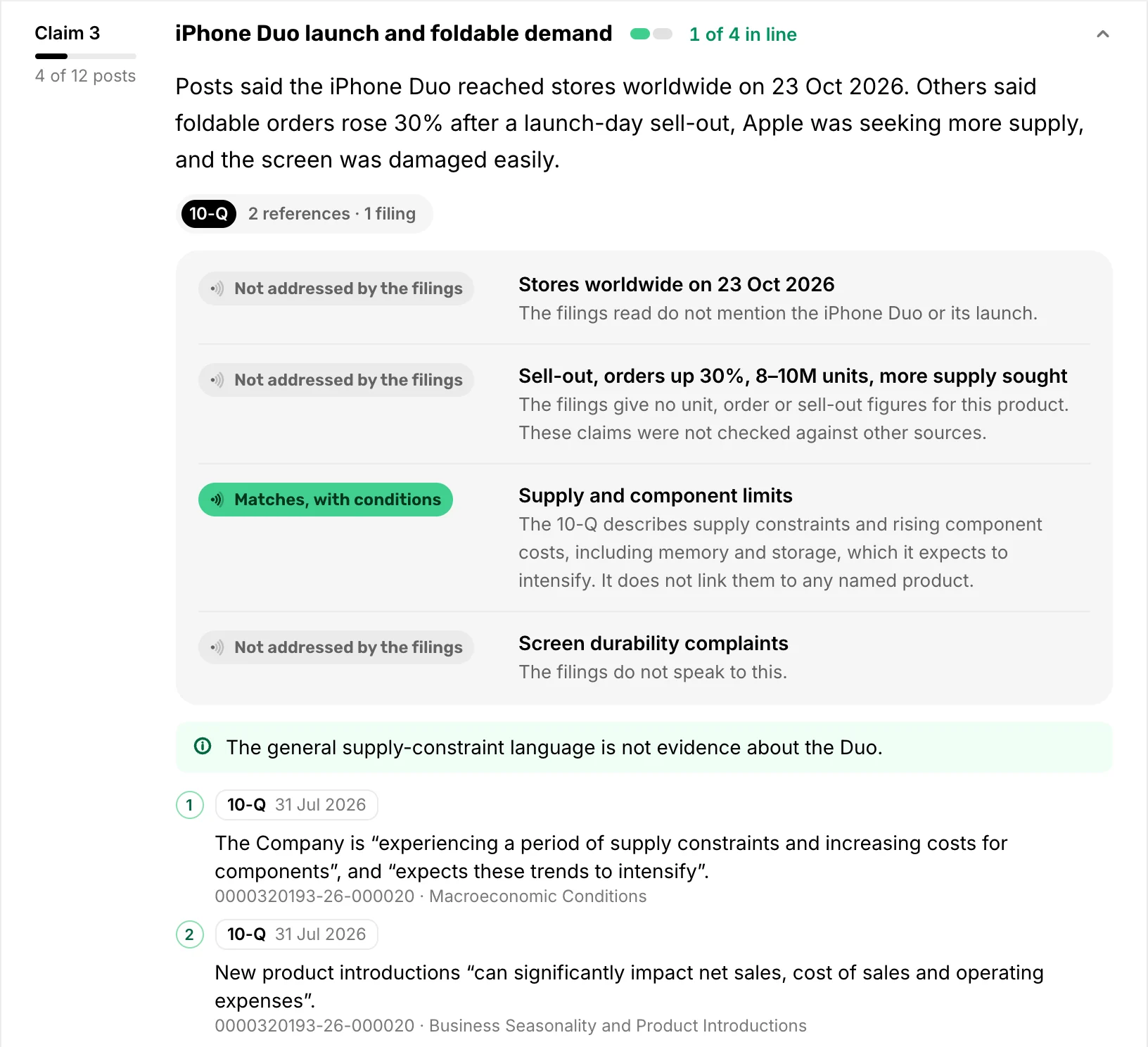
- Matches, with conditions: supply and component limits. The 10-Q says the company is experiencing supply constraints and rising component costs and expects them to intensify, but it does not tie that to any named product.
- Not addressed by the filings: the launch date, the sell-out, the order and unit figures, and the screen complaints. No filing mentions the product.
“Matches, with conditions” is the most important result to read carefully. The filing says something close to the claim, but narrower. Here the card’s note is exact: the general supply-constraint language is not evidence about the Duo.
Costco shows the same pattern with a 10-K. Posts described several consumer class actions against the company. The 10-K of 7 October 2026 does describe consumer class actions, but about a different product line, so the part “Costco faces consumer class actions” matched with conditions, while the specific cases in the posts were not addressed by the passages read.
What is a Form 4? Insider trading filings explained
Officers, directors and anyone holding more than 10% of a class of a company’s shares are insiders for reporting purposes. Investor.gov explains that they must report purchases, sales and holdings on Forms 3, 4 and 5. Form 4 is the one that shows a change, and it is generally due within two business days of the transaction. “Insider trading filings” in this sense are routine disclosure, not a sign of anything improper.
The part people skip is the transaction code in Table I. A few of the common ones:
| Code | What it means |
|---|---|
| P | An open-market or private purchase |
| S | An open-market or private sale |
| A | A grant or award from the company, such as restricted stock units |
| F | Shares withheld or delivered to pay tax or an exercise price, typically when an award vests |
| M | An option or other derivative being exercised |
Then read the footnotes, under “Explanation of Responses”. They often say why the transaction happened.
Two real examples from the same week. Costco posts said several executives and directors had filed Form 4s reporting “special transactions”, without saying what those were. The card found Form 4s filed for Costco on 26 and 27 October 2026, so that part matched. The part “what the transactions were” matched with conditions: the one Form 4 read with explanatory notes (27 October 2026) describes a restricted stock unit grant and a tax withholding on vesting, and the other Form 4s were read only in part. The card’s note is the lesson: a code other than an open-market purchase or sale does not, by itself, mean an insider traded in the market.
For Apple, posts reported a sale by a senior executive. A Form 4 matched the date and the share count the posts gave. The part that treated the sale as meaningful matched only with conditions, because the Form 4 footnote says the sale was made under a Rule 10b5-1 trading plan adopted months earlier, and the 10-Q’s section on insider trading arrangements describes that plan. A pre-arranged plan does not show what the seller thinks about the stock now. A further claim, a 90-day total of insider sales, was not addressed: the Form 4s read do not add up to it, and it was not checked elsewhere.
How to read SEC filings to check a stock claim, in five steps
- Split the claim into parts. A date, a number, an event and an interpretation are four different checks. Write them down separately.
- Choose the form that would have to contain each part. Reported results: the 8-K results release or the 10-Q. Company-described risks and lawsuits: the 10-Q or 10-K. Insider transactions: Form 4. Forecasts, unit sales and opinions: usually no filing at all.
- Find the filing on EDGAR. Search the company, filter by form type, and check the filing date against the claim’s date. A form type ending in /A is an amendment to an earlier filing.
- Read the section, not the whole document. For an 8-K, the item and the attached exhibit. For a 10-Q or 10-K, the management’s discussion, risk factors or legal note. For a Form 4, Table I, the transaction code and the footnotes.
- Mark each part. Matches the filings; matches with conditions (say which); not addressed by the filings; or opinion, not something a filing can settle.
The last step is where honesty matters. Do not round “matches with conditions” up to “true”, and do not round “not addressed” down to “false”. Both shortcuts are how a partly supported claim turns into a story.
SEC filings search: where to find them
Every filing above is on the SEC’s EDGAR database, which anyone can search at no cost. Investor.gov’s guide to using EDGAR to research investments explains the basics: search by company name or ticker, read the form type in the first column of the results, and note that “/A” marks an amendment. Each filing has an accession number, the long identifier shown under every passage in an evidence card, so you can open exactly the document that was read.
Two practical cautions. First, check the date: a filing dated after the posts cannot be what the posts were based on, and a filing dated long before may be out of date. Second, a page that looks like a filing is not one. Screenshots, repost accounts and summaries can drop the footnote that changes the meaning, as the Costco example shows.
How the stocksonar evidence card does this
The evidence card runs the same five steps at the scale of a whole week of posts. It samples the stored posts about a ticker, groups the claims that keep coming back, splits each into parts, and reads each part against the company’s filings dated on or before the end of the window.
| Card | AAPL | COST |
|---|---|---|
| Window | 26 Oct to 1 Nov 2026 | 26 Oct to 1 Nov 2026 |
| Filings read | 9 (10-Q, 8-K, Form 4) | 8 (10-K, 10-Q, 8-K, Form 4) |
| Posts read | 120 (sampled from 1,137) | 120 (sampled from 149) |
| Posts cited | 12 | 20 |
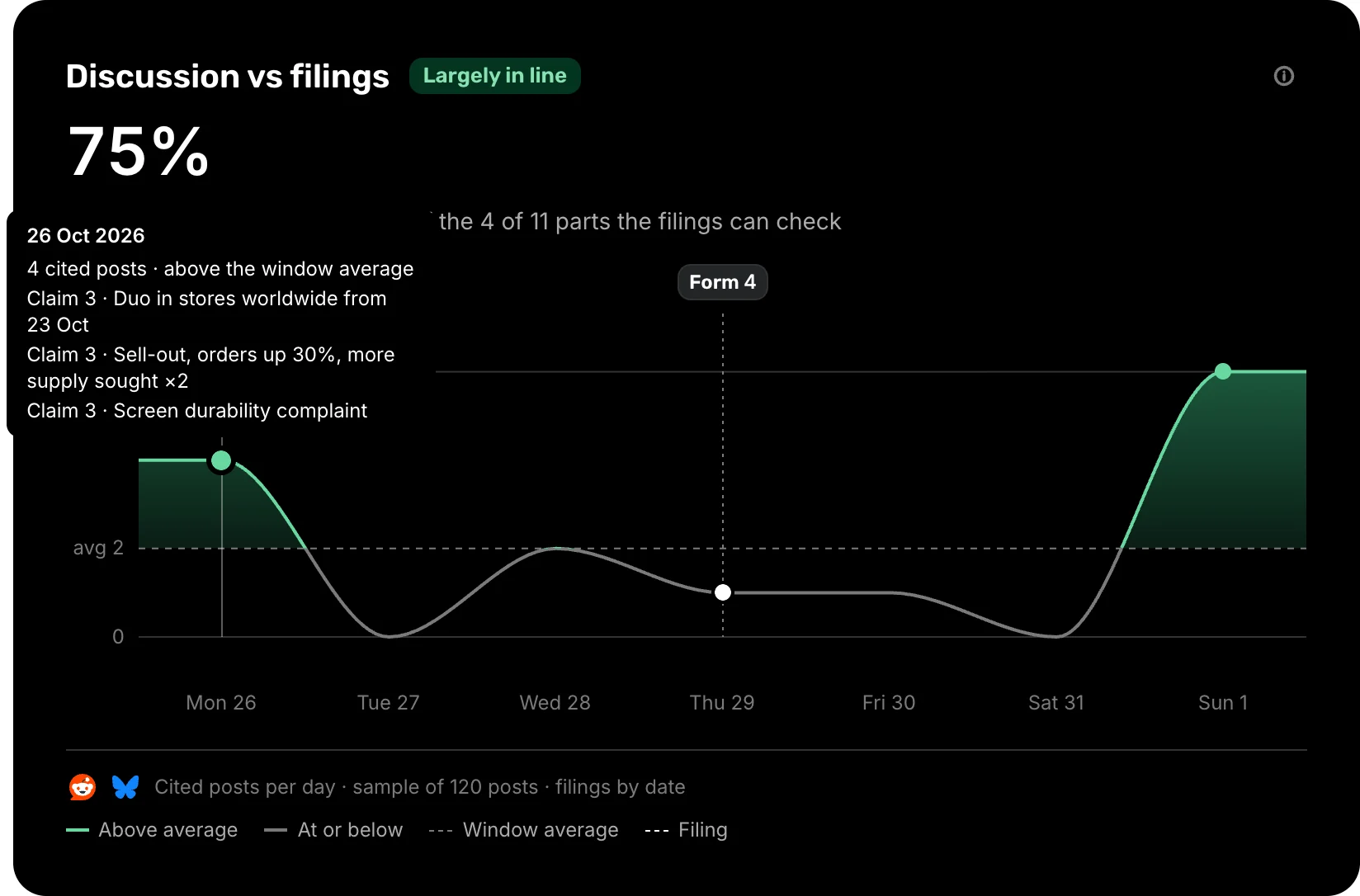
For Apple, the card found 11 claim parts: 2 matched, 2 matched with conditions, 6 were not addressed by the filings, and 1 was opinion. Of the 4 parts the filings could check, 3 were in line, so the card reads 75%, largely in line. The full reading of that week is in the AAPL case study.
The card does not decide whether a post is honest, and it does not look at whether the conversation is organic discussion or coordinated posting; the behaviour checks do that. It answers one narrower question: does what people are saying line up with what the company has filed?
What filings can’t tell you
- Anything the company has not had to report: unit sales, order books, store traffic, private estimates.
- Forecasts by anyone other than the company, and often not even the company’s own: many results releases carry no guidance.
- Why an insider made a trade, beyond what the footnotes say.
- Whether a lawsuit’s allegations are correct, or how it will end.
- How the share price will move, or whether any investment suits anyone.
The rules behind every reading are on the Method page.
Questions
What is an 8-K?
A current report. US public companies file a Form 8-K to announce major events shareholders should know about, generally within four business days of the event. Quarterly results are usually attached to one as a press release.
What is a Form 4?
The form company insiders (officers, directors and holders of more than 10% of a class of shares) file to report a change in what they own, generally within two business days. Each line carries a transaction code that says what kind of change it was.
If a claim is not in the filings, is it false?
No. Not addressed means the company’s own filings say nothing either way. The claim may be true, false or unknowable from filings; it simply rests on the posts alone until another source confirms it.
Does an insider sale on a Form 4 mean the insider expects the stock to fall?
Not by itself. Many sales are made under a trading plan adopted months earlier, or are shares withheld for tax when an award vests. The Form 4 footnotes usually say which.
Is this investment advice?
No. stocksonar describes public conversation about a stock and checks what is said against the company’s filings. It gives no view on the stock and no price prediction.
Data: stocksonar evidence cards for AAPL and COST, window 26 Oct to 1 Nov 2026, filings dated on or before 1 Nov 2026. The cards are prepared with AI assistance from stored material and are not reviewed by an independent analyst. How stocksonar measures · Disclosures. Describes public conversation, not the security. Not investment advice.