How to tell if stock hype is real comes down to two questions, asked in order: is the conversation actually louder than this stock’s own normal, and does it behave like real people talking, or like an organised push? Only after that does it make sense to check what the posts claim against the company’s filings. This guide walks through each step with a real stocksonar reading of Apple (AAPL) from 3 November 2026.
Loud is not the same as fake. A stock can be at many times its usual volume of posts and still be ordinary discussion, and a quieter stock can carry an organised pattern. Telling them apart takes a baseline and a handful of behaviour checks, not a gut feeling about the tone of the posts.
How to tell if stock hype is real: the four checks
| Step | The question | What stocksonar shows |
|---|---|---|
| 1 | Is it louder than its own normal? | The activity multiple against the stock’s previous 30 days (the noise floor) |
| 2 | Do the posts behave normally? | Five behaviour checks, each against the same stock’s history |
| 3 | How many checks point the same way? | The classification: organic discussion, coordination suspected, or insufficient data |
| 4 | Do the claims match the filings? | The evidence card: each claim part checked against SEC filings |
Step 1: is the stock buzz actually above its normal?
Every ticker is compared with itself. The noise floor is the stock’s own normal level of conversation over its previous 30 days, and the activity multiple says how far today sits above it: 1.0× is a normal day, 2.0× is twice it. It is never a comparison with another stock, because a quiet small company and a mega-cap have completely different normals.
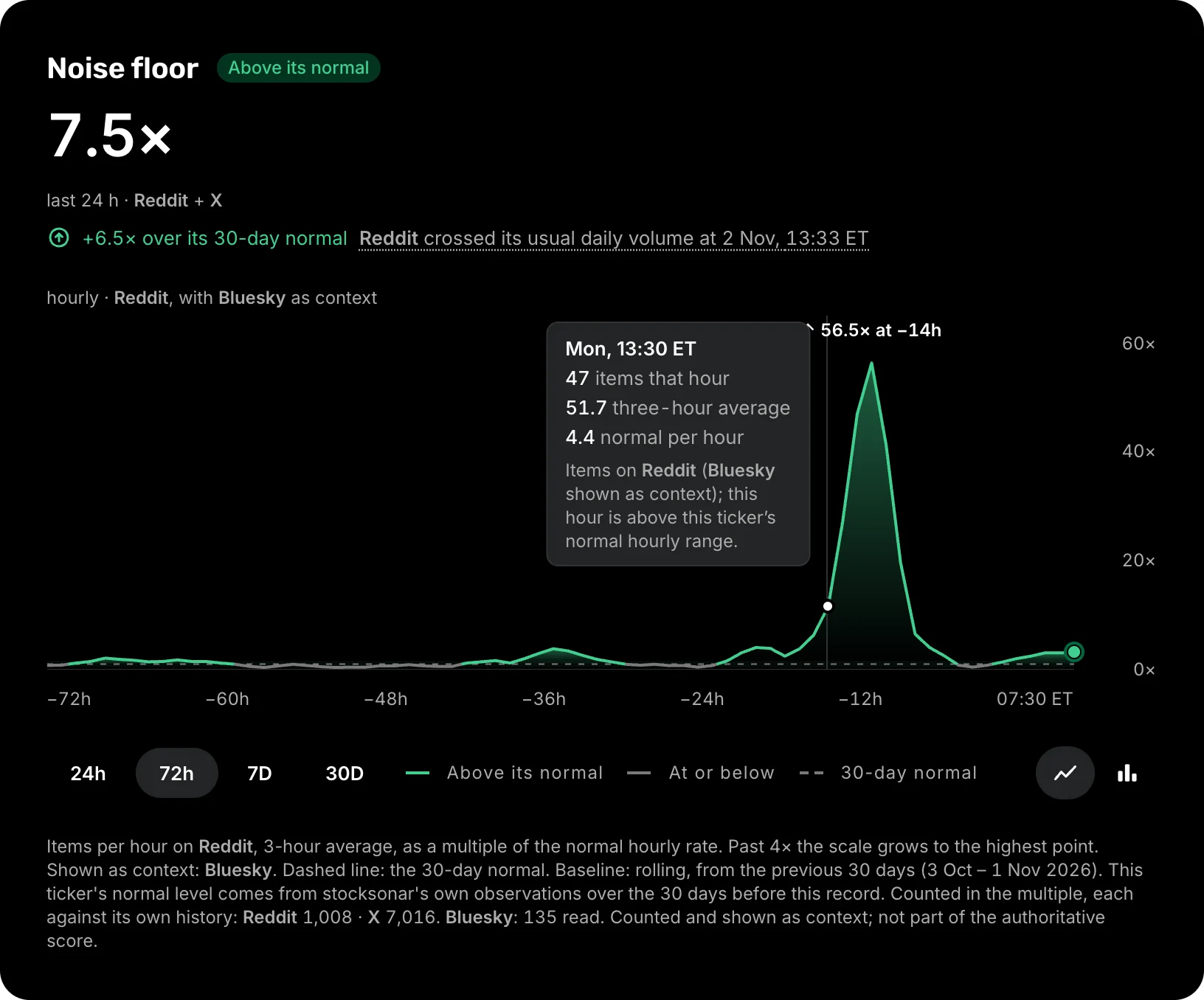
On 3 Nov 2026, Apple’s conversation ran at 7.5× its 30-day normal over the last 24 hours. Reddit crossed its usual daily volume for AAPL at 13:33 ET on 2 November, and at the peak, about 14 hours before the end of the chart, Reddit ran at 56.5× its normal hourly rate. That is unmistakably loud. It still tells you nothing about whether the conversation is genuine, which is why the next step exists.
Compare Costco (COST) on the same day: 1.9× its normal, from 26 Reddit posts by 20 accounts. A stock does not need to be the loudest in the market to be worth a look; what matters is the change against its own history.
Step 2: do the posts behave like ordinary discussion?
This is the part a human reader cannot do by scrolling. Each check compares how today’s posts behave with how posts about the same stock usually behave:
| Check | What it looks at | AAPL, 3 Nov 2026 |
|---|---|---|
| Account age | How much of the discussion comes from recently created accounts | 0% of posting accounts created in the last 3 days · baseline 0% · within |
| Text similarity | How often posts share identical or near-identical wording | 2% of posts · baseline 2% · within |
| Timing clusters | Whether posts arrive in tight bursts rather than spread over time | 4 bursts of 21+ posts, each inside 90 seconds · baseline 0 · outside |
| Source concentration | Whether a few accounts produce a large share of the posts | 12 accounts produced 12% of posts · baseline 39% · within |
| Amplification | Repost and reply patterns around the posts | No repost activity in the sample · observed only |
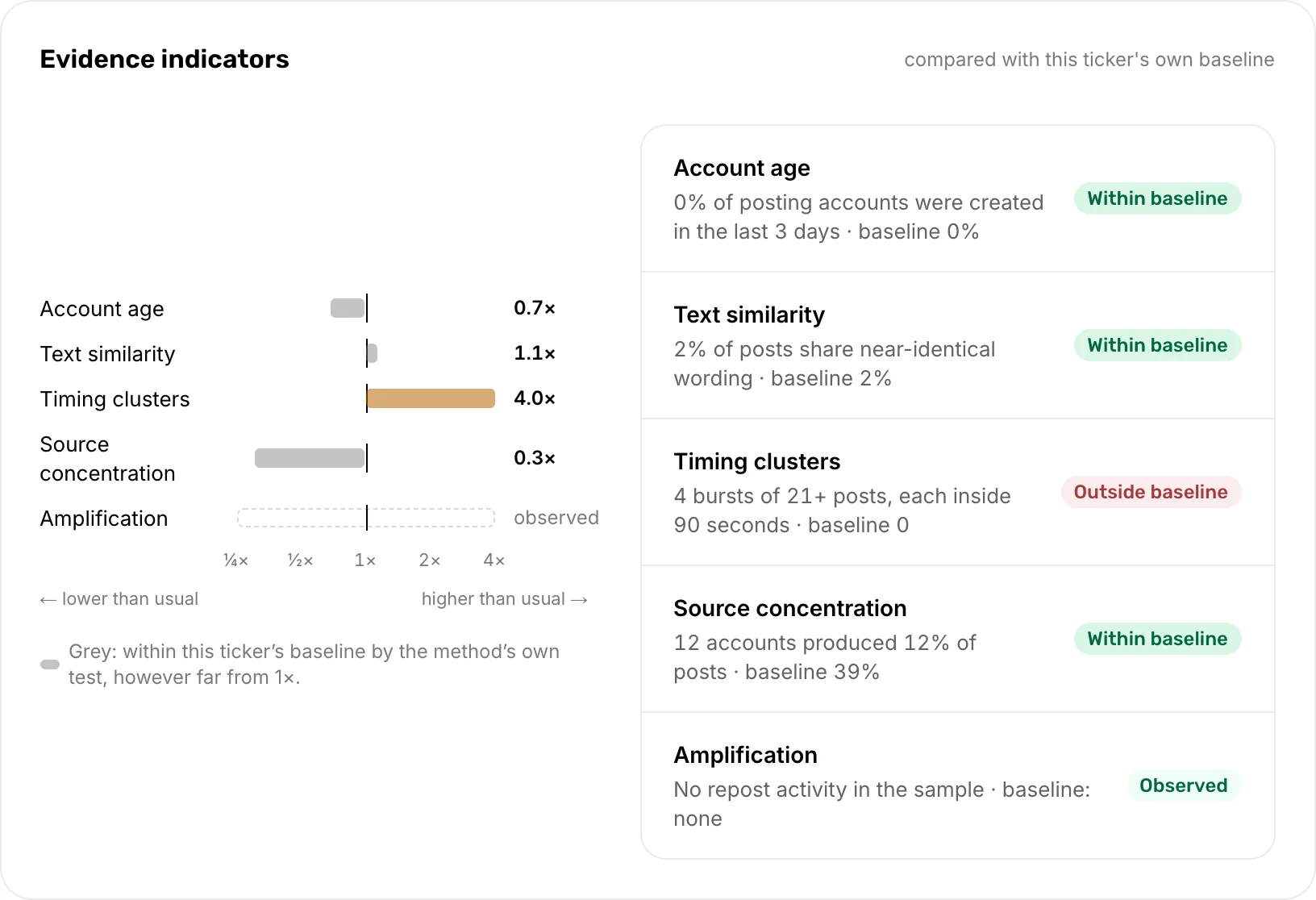
Notice what this does not measure: whether the posts are positive or negative. Tone is easy to fake and easy to misread. Behaviour is harder to fake at scale: a hundred accounts can be told what to say, but making them post at natural, scattered times, from aged accounts, in their own words, is much harder.
Step 3: how many checks point the same way?
No single check decides anything. A burst of posts can be a live earnings event; similar wording can be people quoting the same headline. What matters is how many checks sit outside the stock’s normal range, how far, and whether they converge on the same narrative. The record gives one of three readings:
- Organic discussion: the checks sit within the stock’s normal range and the discussion is spread across many independent accounts.
- Coordination suspected: several checks sit outside the normal range and point at the same narrative, in a pattern consistent with coordinated posting. This describes a pattern in public posts, not intent, fraud or illegal market manipulation.
- Insufficient data: not enough posts or history to judge, or the platforms read disagree. stocksonar says so instead of guessing.
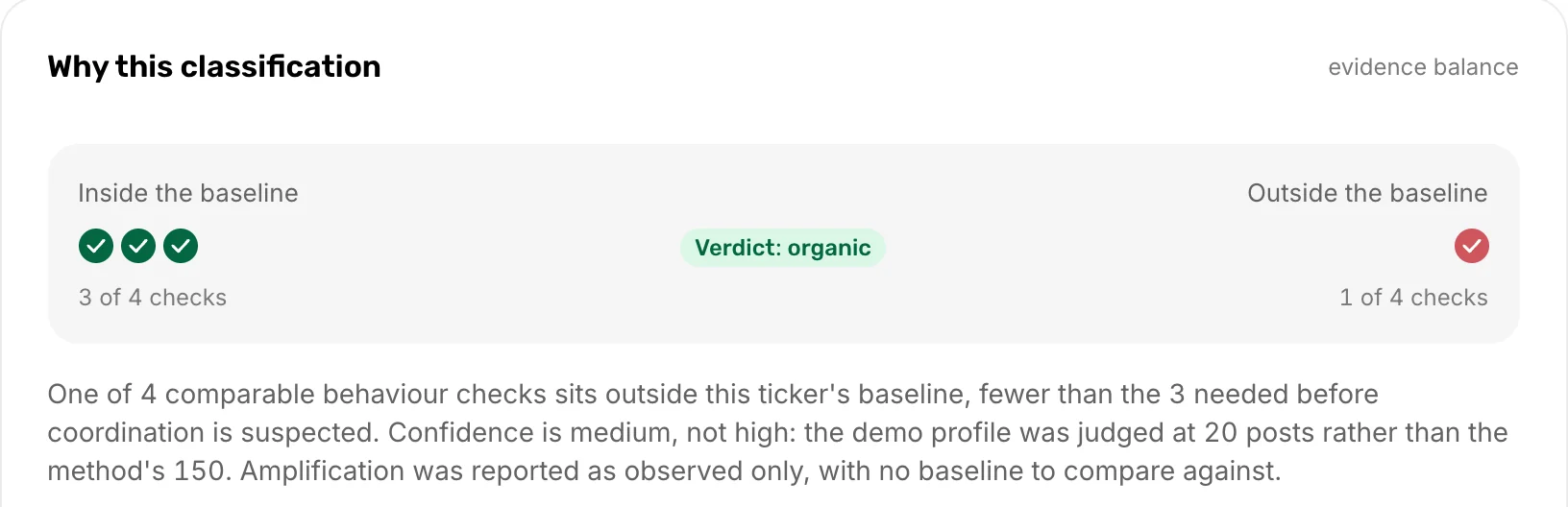
For AAPL, 1 of 4 comparable checks sat outside the normal range (timing clusters). The record states that this is fewer than the 3 needed before coordination is suspected, so the reading was organic discussion, medium confidence. Reddit (1,008 posts) and Bluesky (135 posts) were each judged on their own posts against their own 30 days, and both came out organic.
Confidence matters as much as the label. AAPL’s was medium, not high, because the demo profile judges at 20 posts rather than the method’s 150. Costco’s reading on the same day was organic at low confidence: all 3 comparable checks sat inside its normal range, but the sample was 26 posts and one platform returned only partial coverage. A low-confidence organic reading says the behaviour looked ordinary in a small sample, nothing more.
Step 4: do the claims match the filings?
Organic discussion can still be wrong. Real people repeat rumours, misread numbers and quote each other. So the last step is about what is being said: the evidence card takes the claims repeated in the posts, splits them into checkable parts, and reads each part against the company’s SEC filings (10-Q, 8-K, Form 4).
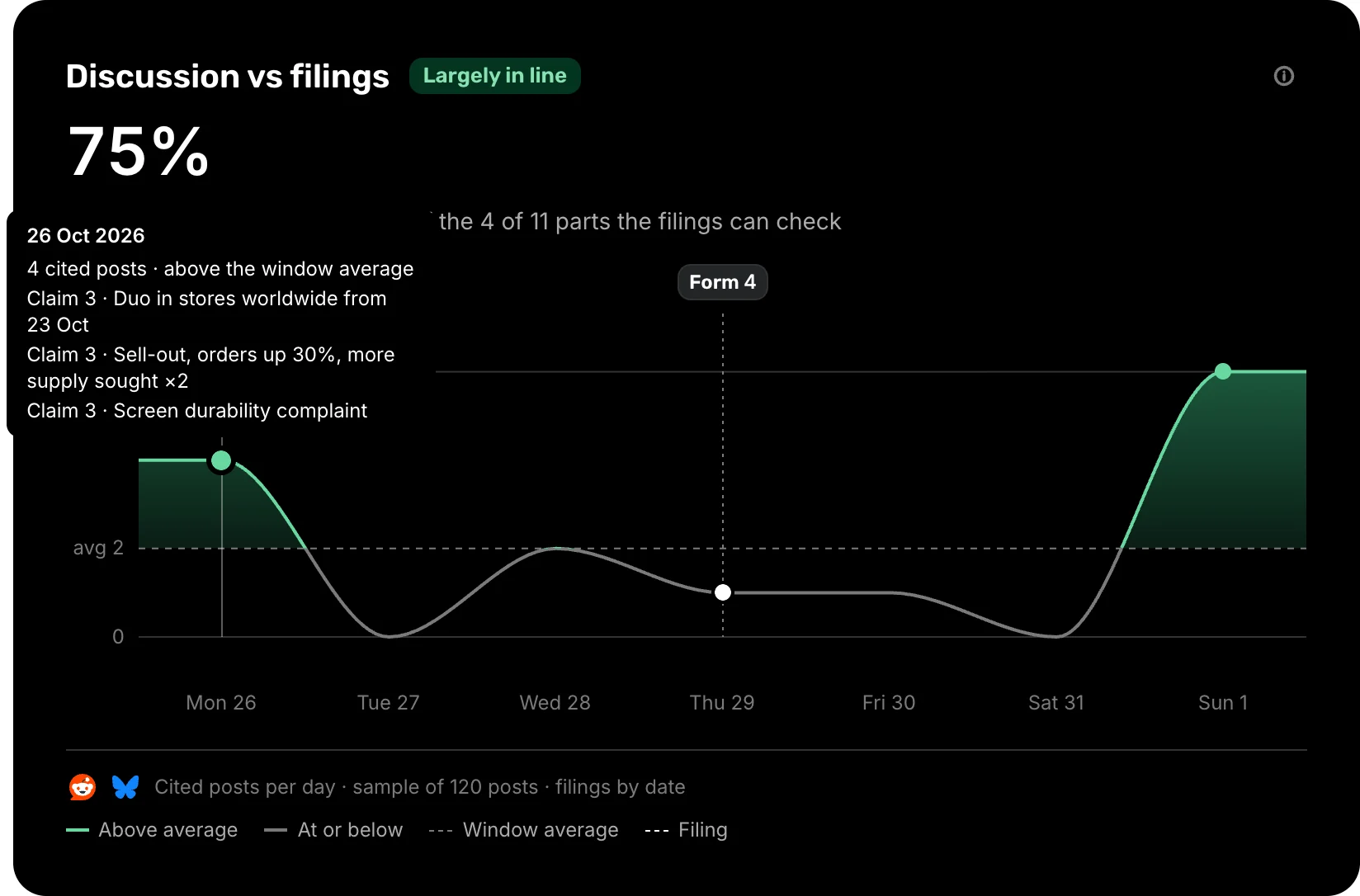
For Apple’s window of 26 Oct to 1 Nov 2026, the card read 9 filings against 120 posts and found 11 claim parts. Of the 4 parts the filings can check, 2 matched and 2 matched with conditions: 75%, largely in line. 6 parts were not addressed by the filings at all, including the launch-week numbers people repeated about the new iPhone Duo, and 1 was opinion.
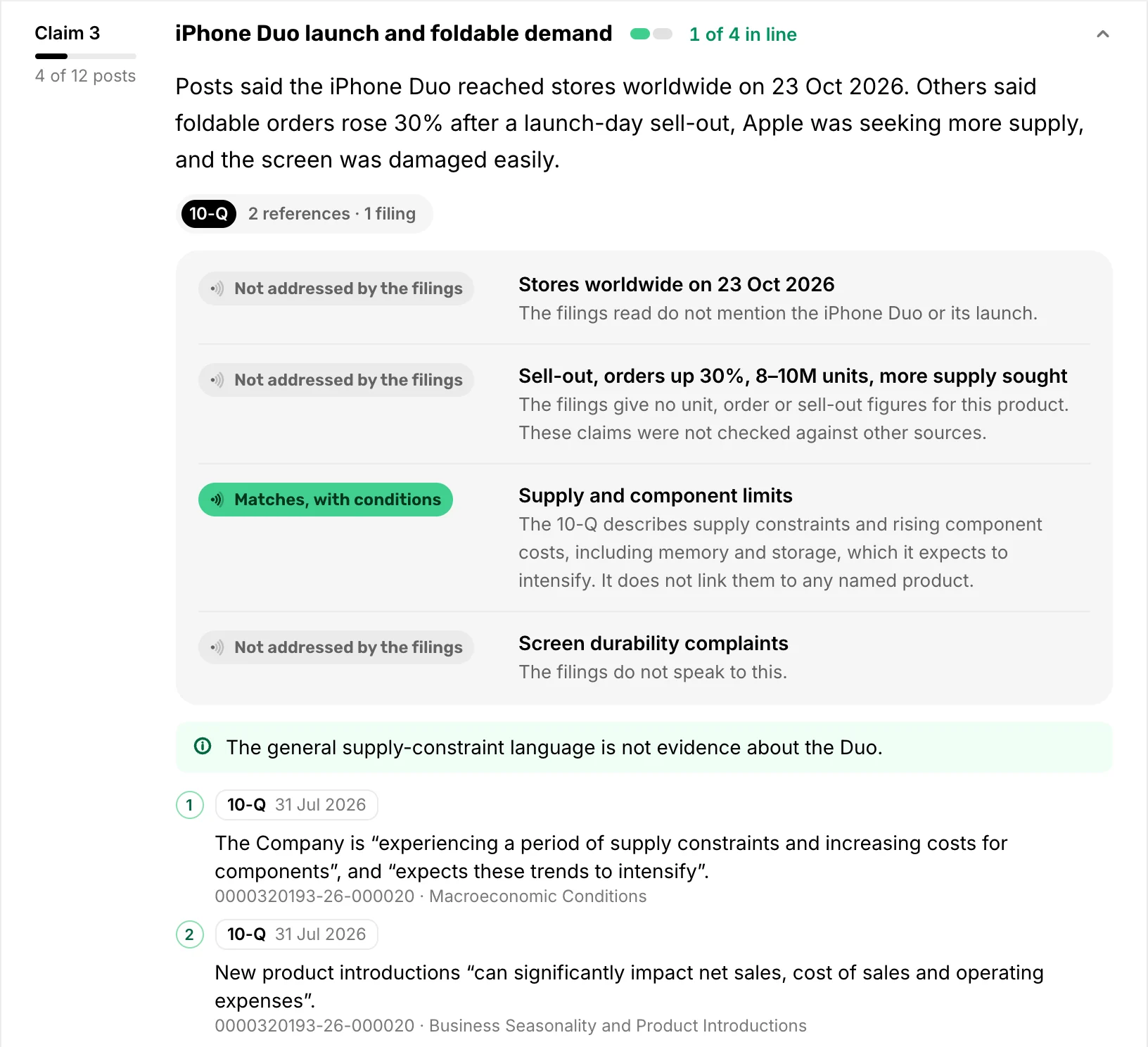
“Not addressed by the filings” is not the same as false. It means the company’s own reports say nothing either way, so the number rests on the posts alone. That is exactly the kind of figure worth checking somewhere else before it shapes your view.
How to spot market manipulation in social posts
Regulators describe the classic pattern plainly. Investor.gov explains that in a pump-and-dump scheme promoters push a stock with false or misleading statements and unload their shares once the price rises, and that this is not limited to tiny companies. Its notes on social media and stock rumors and on social media stock scams point at accounts with little posting history, anonymous or impersonated promoters, and pressure to act fast.
Those warnings map onto behaviour you can measure:
- Many new or near-silent accounts appearing at once → account age.
- The same sentences pasted across posts → text similarity.
- Posts landing in tight bursts, minutes apart → timing clusters.
- A handful of accounts producing most of the volume → source concentration.
- Everything amplifying one claim, not many conversations → narrative convergence.
One pattern on its own is common and harmless. Several at once, around the same story, is what deserves a closer look. Even then, a pattern in posts is not proof of anyone’s intent.
Is WallStreetBets legit as a source?
WallStreetBets and the other large stock communities are full of real people, and most of what happens there is ordinary discussion. The useful question is not whether a community is legit, but whether today’s conversation about one stock behaves the way that stock’s conversation usually behaves. stocksonar reads Reddit over a fixed set of equity communities and compares each ticker with its own history there, so a busy day on a busy forum is not mistaken for something unusual.
What the data can’t tell you
- The intent of any person or account, or whether anyone was paid to post (unless the post says so).
- Whether a claim is true, only whether the filings support, qualify or do not address it.
- Anything said in private groups, direct messages, or on platforms that were not read.
- How, or whether, the conversation will affect a price.
The full rules are on the Method page, and the worked example above is the AAPL case study for 3 Nov 2026.
Questions
How can you tell if stock hype on Reddit is real?
Ask two questions in order. Is the conversation actually louder than this stock’s own normal, and by how much? Then: do the posts behave like ordinary discussion, or do several behaviour checks (timing, wording, who is posting) sit outside the stock’s normal range at once? Only then check the claims themselves against the company’s filings.
Is a big spike in posts a sign of manipulation?
No. Volume alone says nothing about coordination. On 3 Nov 2026 Apple’s conversation ran at 7.5× its normal and was still read as organic discussion, because 3 of 4 comparable behaviour checks sat inside its normal range.
Can stocksonar tell who is behind a coordinated push?
No. It describes patterns in public posts. It cannot determine anyone’s intent, whether a post was paid for, or whether any activity is legal. That is for regulators and courts.
Is this investment advice?
No. stocksonar describes public conversation about a stock, measured against that stock’s own normal. It gives no buy or sell view and no price prediction.
Data: stocksonar production readings of 3 Nov 2026 (14:28 UTC), Transducer v2.8, demo profile. How stocksonar measures · Disclosures. Describes public conversation, not the security. Not investment advice.