Timing clusters is the behaviour check that asks whether posts about a stock arrive in tight bursts (many posts inside a minute or two) rather than spreading out over time, compared with that stock’s own history.
Why timing clusters matter
People who find a story on their own post when they get to it: over minutes and hours, at scattered times. An organised push often has a start time. Bursts are hard to hide when many accounts act on one cue, which is why the check is one of five in how to tell if stock hype is real.
How stocksonar measures it
The check counts bursts of posts that land inside a short window, and compares that count with the same stock’s baseline. A burst on its own is not suspicious: earnings releases, product launches and breaking headlines all produce them.
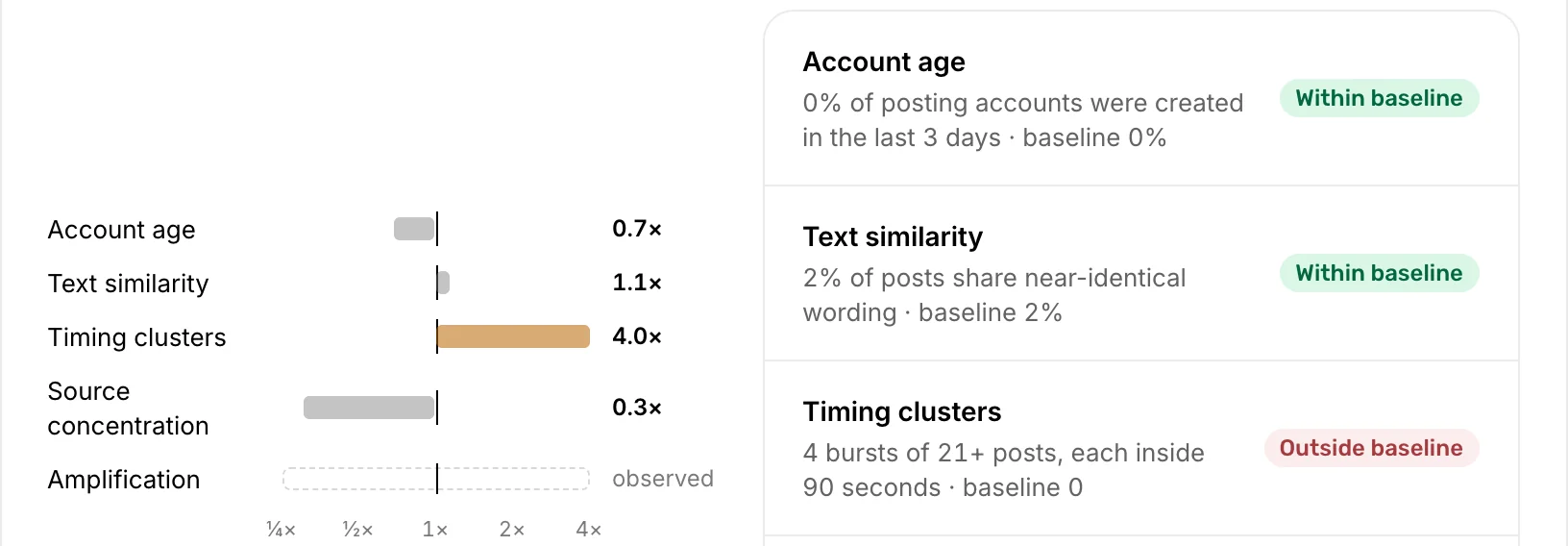
A real reading: on 3 Nov 2026 Apple (AAPL) had 4 bursts of 21 or more posts, each inside 90 seconds, against a baseline of 0, so this check sat outside its normal range (4.0× on the chart). Costco the same day had no bursts of 20 or more posts inside 90 seconds, within its normal range.
Common confusions
A timing cluster is not proof of coordinated posting. AAPL’s bursts came in a week when posts were discussing a product launch and quarterly results, and the other 3 comparable checks sat inside the normal range, so the reading stayed organic discussion. The next check worth making is whether the accounts in a burst usually post at that hour, and whether the burst began before or after a filing or announcement. See the AAPL case study.
Questions
Do timing clusters mean bots?
Not on their own. Bursts also follow real news. The check matters when it sits outside the stock’s normal range together with other checks.
What counts as a burst?
In the AAPL reading of 3 Nov 2026, 21 or more posts inside 90 seconds. Each record states the bursts it found and the stock’s baseline.
Data: stocksonar production readings of 3 Nov 2026 (14:28 UTC), Transducer v2.8, demo profile. How stocksonar measures · Disclosures. Describes public conversation, not the security. Not investment advice.