Pump and dump explained in one sentence: someone spreads false or misleading information to create a rush of demand for a stock, the price is “pumped” up, and they “dump” their own shares at the inflated price. Once they have unloaded and the hype stops, the price usually falls, and the people who came in late are the ones who lose money. That is how Investor.gov, the SEC’s site for individual investors, describes pump and dump schemes.
This guide covers how the scheme works, why it is illegal, what real cases looked like, and what the posting patterns behind a pump can look like on Reddit, X and other platforms. It is part of how to tell if stock hype is real, and it ends with a real stocksonar reading that shows why a loud stock is not the same as a pumped one.
Pump and dump explained: the three stages
How pump and dump works is the same in every version, old or new: three moves. The channel changes (phone pitches and faxes once, chat groups and social posts now); the structure does not.
| Stage | What the promoters do | What it can look like in public |
|---|---|---|
| 1. Position | Quietly acquire shares, often cheaply, before any promotion starts | Nothing yet. This stage is invisible in posts |
| 2. Pump | Push a story: a contract, a takeover, a breakthrough, a level the price “will” reach | A sudden wave of posts, the same claims in similar words, many new or quiet accounts, posts landing in bursts |
| 3. Dump | Unload shares into the demand the story created, then go quiet | The posts stop or turn to blame; the story is not followed by any filing or company news |
Investor.gov lists the channels the false information travels through: social media, investment research websites, newsletters, online ads, email, chat rooms, and older media such as direct mail and radio. It also notes that microcap companies (generally a market value under $250 or $300 million) are particularly vulnerable, because so little public information about them exists that a made-up story is hard to check.
Is pump and dump illegal?
Yes. A pump and dump is a form of market manipulation, which Investor.gov defines as someone artificially affecting the supply or demand for a security. Its examples include spreading false or misleading information about a company, making a security look more actively traded through a series of transactions, and rigging quotes, prices or trades. The SEC pursues these cases as securities fraud in civil court, and the Department of Justice can bring criminal charges for the same conduct.
Two lines are worth knowing. First, undisclosed promotion: a person paid in shares to talk up a stock who then unloads those shares while still promoting it, without saying so, is a practice known as scalping. Second, honest opinion is not manipulation. Posting that you own a stock and like it is legal; what turns it into fraud is false or misleading information, hidden plans to unload, or hidden payment.
Whether any particular post or account crosses that line is a legal question. stocksonar does not answer it, and neither should a screenshot or a comment thread.
Pump and dump examples from SEC cases
Influencers on Twitter and Discord (2022). On 14 December 2022 the SEC announced charges against eight individuals in what it described as a $100 million securities fraud scheme. According to the complaint, seven of them presented themselves as successful traders, built hundreds of thousands of followers on Twitter and in Discord trading chat rooms, purchased certain stocks and then encouraged their followers to do the same by posting price levels or saying they were holding or adding to positions.
When prices or volumes rose, they allegedly unloaded their shares without having disclosed that plan. An eighth was charged with aiding the alleged scheme through a podcast that promoted the others. Criminal charges were filed in a parallel case.
These are allegations made in a complaint, not findings.
Two details in that case matter for anyone reading stock posts. The stocks were exchange-traded, not obscure penny stocks. And the promotion did not look like an advertisement: it looked like confident traders sharing their own positions.
Paid promotion of microcaps. Investor.gov’s note on stock rumors on social media describes an earlier SEC case in which a couple used a penny-stock website, Facebook and Twitter to promote microcap companies, received millions of shares as compensation, and allegedly unloaded them around the time their site predicted large price rises, without fully disclosing the compensation. The court ordered more than $3.7 million in disgorgement and $300,000 in civil penalties.
Impersonation. The same note describes a case in which, the SEC alleged, an individual moved the share prices of two companies by posting false rumors from Twitter accounts made to look like established securities research firms. Rumors can push a price down as well as up.
Pump and dump on Reddit and other social platforms
On Reddit, X, Stocktwits, Discord and Telegram a pump rarely announces itself. It arrives as a crowd that appears from nowhere. The same Investor.gov note on stock rumors lists warning signs: accounts with a limited history of posts, and sources that conceal their identity or impersonate credible ones. Investor.gov’s February 2026 note on stock recommendation scams on social media adds promises of large gains with little or no risk, and group chats that investors are pulled into from an online ad.
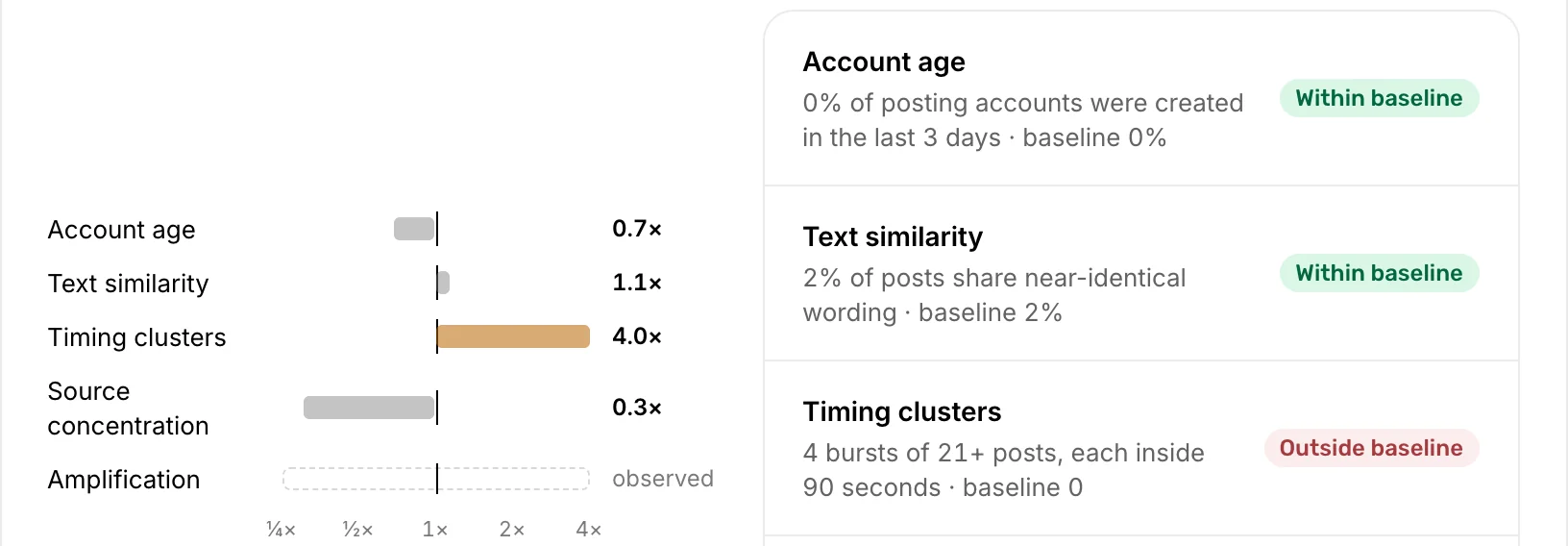
Most of those signs leave a trace in how the posts behave, not just in what they say. That is what the five stocksonar behaviour checks look at, each against the same stock’s own history:
| Pattern in a pump | Behaviour check | What would sit outside the normal range |
|---|---|---|
| Fresh accounts created to push one story | Account age | A larger share of posts than usual from accounts created in the last few days |
| The same message pasted or lightly reworded | Text similarity | More identical or near-identical wording than the stock usually shows |
| Posts dropped together on a schedule | Timing clusters | More tight bursts of posts than the stock’s baseline |
| A few loud accounts doing most of the talking | Source concentration | A small group producing an unusual share of the posts |
| A ring of accounts reposting each other | Amplification | Repost and reply patterns unlike the stock’s history |
No single row proves anything. A burst of posts is what a live results announcement looks like; similar wording is what people quoting the same headline looks like. What matters is several checks sitting outside the stock’s normal range at once and pointing at the same story. stocksonar names that pattern coordinated posting.
Pump and dump detection: what you can check yourself
You do not need a tool to start. Before acting on a story that is suddenly everywhere, work through these questions:
- Is it loud for this stock? Compare today’s volume of posts with the stock’s own usual level, its noise floor. A small company that normally gets five posts a day and now gets five hundred is a different situation from a large one having a busy day.
- Who is posting? Open a few profiles. Accounts created this week, with no history before this stock, are the most common sign in regulators’ guidance.
- Are they saying the same thing? Identical phrases, the same price level and the same deadline across many accounts suggest one source.
- When did it start? Many posts landing within minutes, especially outside the stock’s usual hours, is a pattern worth noting.
- Is the story in the filings? A contract, a merger or a big order would normally show up in an 8-K or a company release. If it is nowhere in the company’s own filings, the claim rests on the posts alone. The method is in how to read SEC filings to check a stock claim.
- Is the promoter disclosing anything? Paid promotion and the promoter’s own position should be disclosed. Silence on both, combined with urgency, is a classic combination.
A loud stock is not a pump: a real reading
The questions above matter because volume alone fools people in both directions. A real example from stocksonar’s production record for Apple (AAPL) on 3 November 2026:
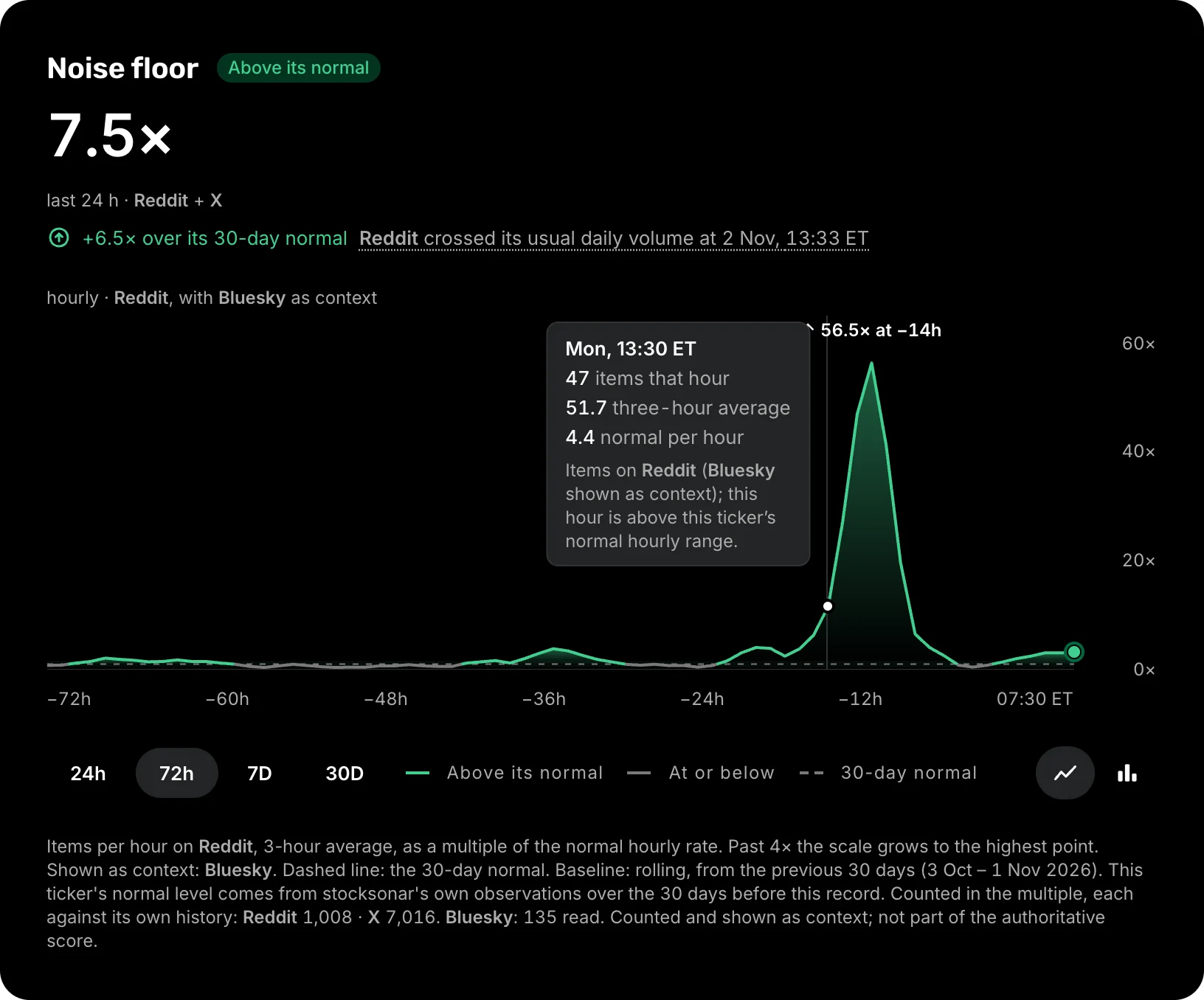
- The conversation ran at 7.5× its 30-day normal over 24 hours, across Reddit (1,008 posts) and Bluesky (135 posts).
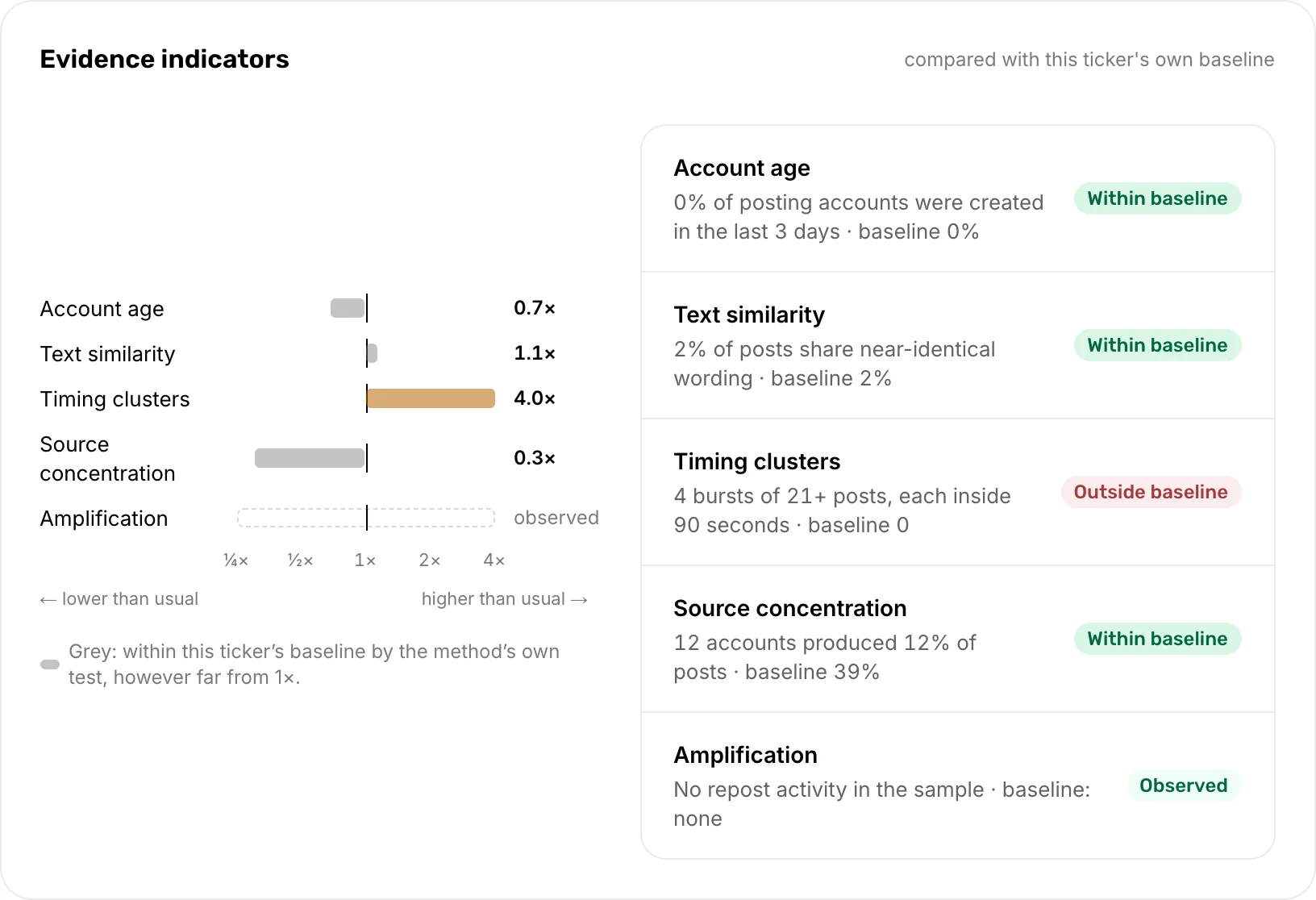
- One check sat outside Apple’s own range: timing clusters, with 4 bursts of 21 or more posts, each inside 90 seconds, against a baseline of 0.
- Account age (0% of posting accounts created in the last 3 days), text similarity (2%, baseline 2%) and source concentration (12 accounts produced 12% of posts, baseline 39%) all sat inside it.
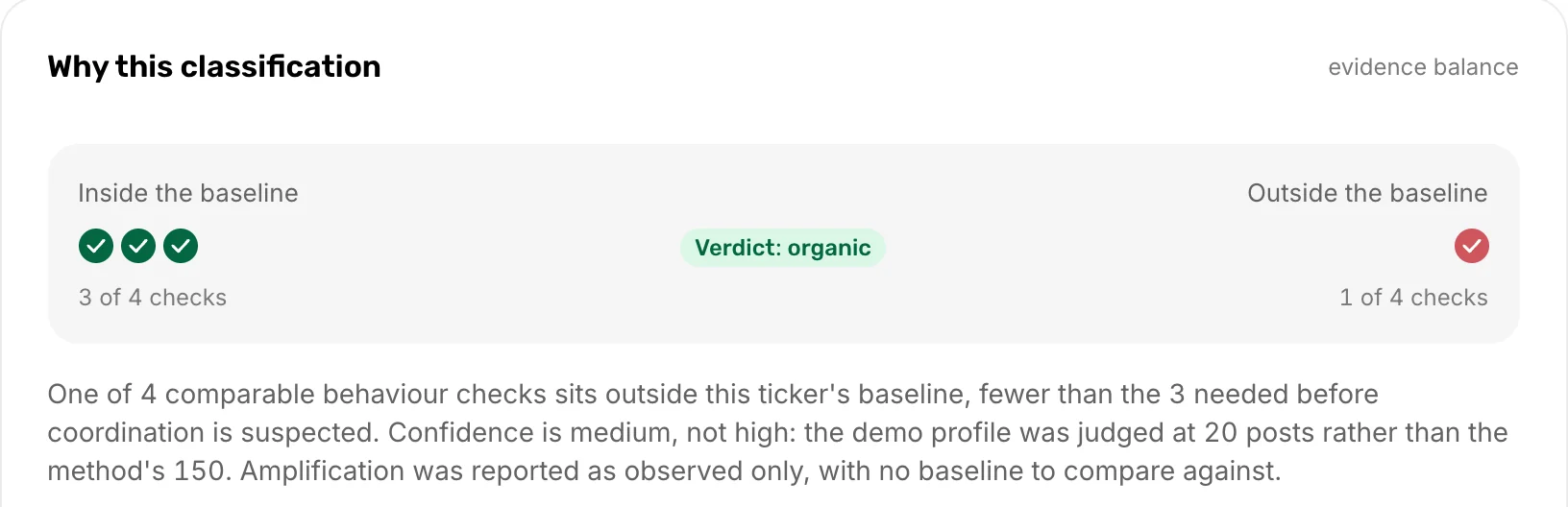
One of 4 comparable checks outside the range is fewer than the 3 the record requires before coordination is suspected, so the reading was organic discussion, at medium confidence. A pump needs fresh accounts, pasted wording or a few accounts doing the talking, usually several at once; this conversation had bursts and nothing else. The full reading is in the AAPL case study.
The reverse also holds. A quiet stock can be pumped inside a single group chat that no public reading sees, which is why the checks describe only the public posts that were read.
What a stocksonar reading does and does not say
- It says how loud the public conversation about a stock is against that stock’s own normal, and whether the posts behave like ordinary discussion, with the numbers behind each check.
- It does not say that anyone committed fraud, who is behind an account, whether anyone was paid, or whether any activity is legal. Coordination suspected describes a pattern in public posts, not intent or illegal market manipulation.
- It does not cover private groups, direct messages, or platforms that were not read.
- It gives no view on the stock or its price.
The rules behind every reading, including how each check is compared with the stock’s history, are on the Method page. If you think a stock is being manipulated, you can report it to the SEC through its website.
Questions
Is pump and dump illegal?
Yes, when it is done the way regulators describe it: spreading false or misleading information to move a stock’s price and then unloading shares into the demand it created. The SEC treats it as securities fraud and market manipulation and brings civil cases; prosecutors can file criminal charges in parallel. Talking up a stock you own and genuinely believe in is not, by itself, a pump and dump.
Does a pump and dump only happen with penny stocks?
No, but small companies are the easiest targets. Investor.gov notes that microcap companies are particularly vulnerable because little public information exists about them. The SEC’s December 2022 case concerned exchange-traded stocks promoted on Twitter and Discord.
What is the opposite of a pump and dump?
Sometimes called short and distort: spreading negative rumors so that holders unload their shares and the price falls, then purchasing at the artificially low price. Investor.gov’s note on stock rumors on social media describes both directions.
Can stocksonar tell me whether a stock is a pump and dump?
No. stocksonar describes patterns in public posts: how loud the conversation is against the stock’s own normal, and whether its behaviour checks sit inside or outside that normal. A reading of coordination suspected is not a finding of fraud, intent or illegal activity. Those are questions for regulators and courts.
Is this investment advice?
No. This guide explains a type of fraud and how public conversation can be read. It gives no view on any stock and no price prediction.
Data: stocksonar production record for AAPL of 3 Nov 2026, Transducer v2.8, demo profile; SEC and Investor.gov pages read on 4 Nov 2026. How stocksonar measures · Disclosures. Describes public conversation, not the security. Not investment advice.